


If you are building an audience on Substack and still treating it like a “newsletter only” platform, you are leaving serious growth on the table. In a recent conversation with WriteStack founder Orel, we explored why Substack’s Notes feature is the true engine of discovery and how his tool helps creators turn that engagement into subscribers, revenue, and long-term control over their audience.
Why Substack Is “Rented Land Insurance”
Substack combines the reach of social media with the ownership of an email list, giving creators the benefits of a feed-driven platform without the fragility of followers they cannot take with them. When someone subscribes on Substack, you get their email, which means that even if the platform bans you or changes direction, you still own the direct relationship with your readers. For creators burned by account bans or algorithm swings on TikTok, X, or other platforms, this ability to build a portable audience is a major shift.
Substack also forces you to develop a long-form writing muscle while still operating inside a social discovery ecosystem. That mix of depth plus distribution makes it one of the strongest opportunities in the current early adopter phase of the platform, before it matures and growth inevitably slows or becomes more competitive.
Substack Notes: The Underrated Growth Channel
When Orel first joined Substack almost two years ago, he treated it like a traditional blog: long-form pieces, organic discovery, and recommendations from other writers. It worked, but slowly. Over time, he realized that the number one driver of new subscribers was not the essays at all. It was Notes.
Across thousands of creators he has spoken with, roughly 30–70 percent of their subscribers come directly or indirectly from Notes activity. In many cases, that means tens of thousands of subscribers attributable to short posts that travel through the feed and get surfaced to new readers.
The most effective Notes on Substack are not generic tips or faceless promo posts. They are personal updates and “building in public” moments. Creators share milestones, failures, wins, and real numbers, such as revenue snapshots. Each transparent update sparks fresh engagement and new subscribers. Many people hesitate to share income or goals publicly out of fear of judgment, privacy concerns, or “jinxing” themselves, but the response pattern is often the opposite. Readers root for you, follow the journey, and want to be part of your next milestone.

Inside WriteStack: Built for Substack Growth
WriteStack was born out of Orel’s own Substack workflow. He needed a way to generate more Notes, schedule them intelligently, and double down on what was actually working. Once you connect, the first screen you see is a Notes hub where you can write, generate, and schedule Notes in batches. A built-in Notes generator can create new posts based on your existing Substack articles or even files you upload, using your own writing style and voice rather than generic AI language.

Scheduling is designed to be as simple as dropping content into a queue and letting it dispatch to the next available slot. You can visualize your entire schedule in one view and rearrange Notes via drag-and-drop to cover your week or month with consistent, high-performing content. For creators who prefer to repurpose, a single Note format that performs well can be duplicated, lightly tweaked, and re-queued, preserving the structure while updating the specifics.
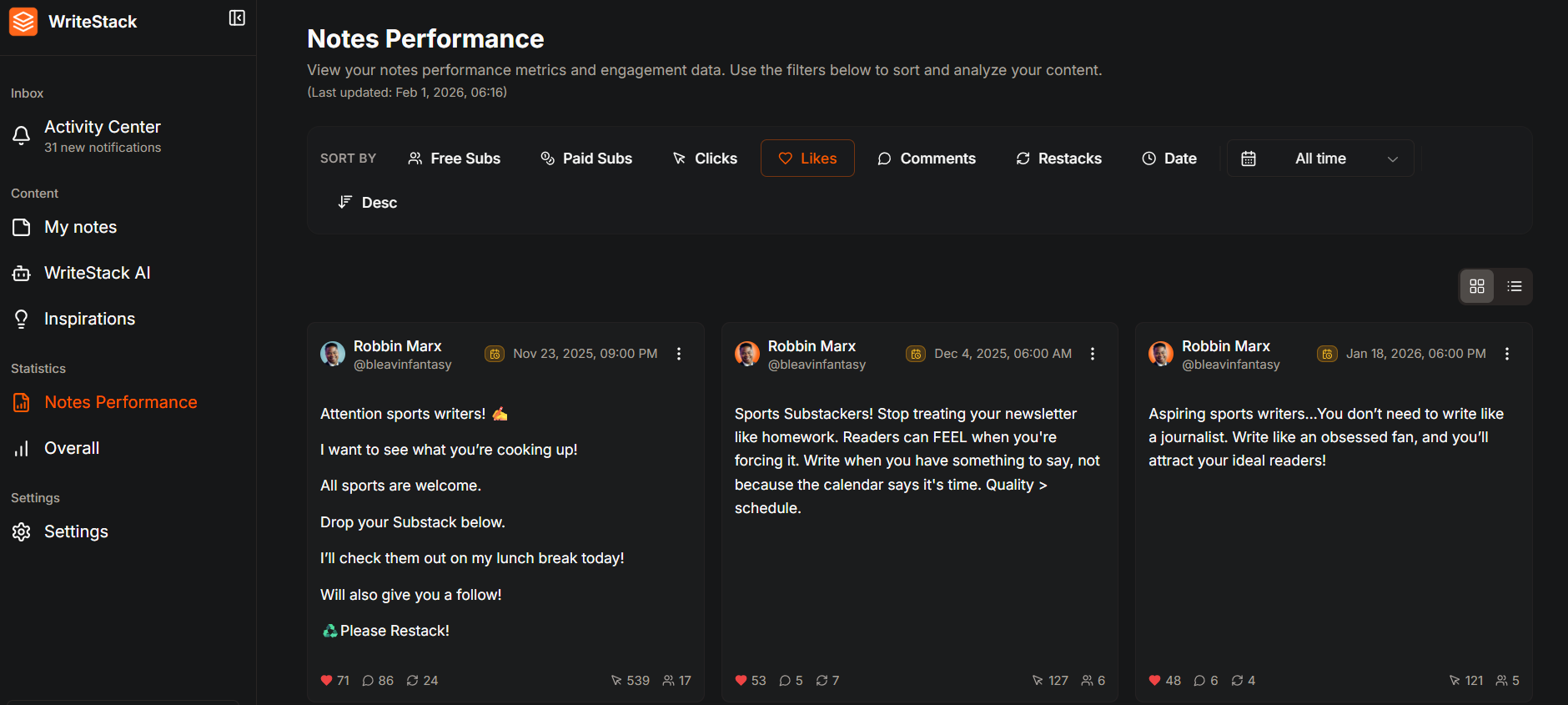
The feature that Orel calls the most valuable is Notes Performance, a sortable dashboard of your full Notes history with metrics like clicks, likes, and subscribers. He routinely filters by likes to identify his highest-engagement Notes, then saves those back to drafts and re-adds them to his queue, so he is constantly resurfacing proven winners. If posting the exact same text feels repetitive, built-in AI tools can generate alternate versions that are more sarcastic, shorter, or differently phrased while keeping the underlying concept intact.
Community, Conversions, and the Activity Center
WriteStack is not just about pushing content out. It also makes creator–reader interaction far less painful. On Substack itself, comments and replies are buried in a noisy notifications tab, difficult to track, and awkward to manage, especially if you navigate away and lose your place. In contrast, WriteStack’s Activity Center pulls everything into a single view, allowing you to respond to comments rapidly with keyboard shortcuts and automatically like comments as you reply. That makes it realistic to handle a large volume of engagement in 15–20 minutes rather than feeling overwhelmed or guilty about unanswered readers.

These interaction patterns matter because Orel has data showing a strong correlation between the Notes he posts, the engagement they receive, and the number of signups WriteStack gets as a business. By optimizing for likes and overall engagement rather than just free subscriber count, he funnels more people to his Substack profile, where a simple, goal-driven tagline invites readers to “join” him as he builds WriteStack to 100K rather than just “buy” a tool. Analytics from an external dashboard confirm that much of his revenue originates from visitors who land via that profile link after discovering him through Notes.

For creators thinking about paid tiers or selling services off-platform, this same model applies. Use Notes to generate engagement, send people to an intentional profile or landing page, and let that page invite them into a larger story or journey rather than a one-off transaction. Transparency, consistent updates, and smart reuse of formats become the engine that powers both audience and revenue growth.
Power Features, Limitations, and What’s Next
Beyond its core tools, WriteStack includes an Inspirations feature that lets users see which types of Notes are performing well across the platform, down to specific formatting tricks like repeated letter patterns or year-stamped lists. WriteStack can even filter the broader database by phrases or engagement thresholds, such as Notes with more than 100 likes, to reverse-engineer what resonates before adapting those formats to their own voice.

On the distribution side, he is actively testing a collaboration with Buffer so creators can compose and schedule Notes in WriteStack and then syndicate that content automatically to other platforms like LinkedIn and X. For creators juggling multiple channels, especially those managing social for organizations or municipalities, this would help connect Substack’s email plus social ecosystem with the rest of their content stack. WriteStack currently offers a seven-day free trial, making it easy for curious Substack writers to test the workflow and see whether they also become “addicted” to the efficiency gains and growth it unlocks.
Try WriteStack!
WriteStack.io is the tool that helped me gain over 5000 subscribers and land on Substack’s Rising in Sports Top 10! It also helped me to scale my Notes output. It’s totally FREE to try it for 7 Days, but if you’re serious about growing on Substack, I’m confident you will subscribe long term. The first 10 people to sign up using the code: ROBBIN10 get a 10% discount. Tell’em the Sport Stackers sent ya!
Final Thoughts and Next Steps
For creators serious about Substack, the playbook emerging from Orel’s experience is clear. Treat Substack as both a social feed and an email list, lean hard into Notes as your primary discovery engine, and share your journey in public through honest, repeatable formats. Add in visual scroll stoppers, prioritize clicks in your analytics, and invest in fast, thoughtful replies to build a loyal audience that follows you beyond any single platform. Tools like WriteStack can compress the time it takes to execute this strategy, turning scattered experimentation into a deliberate, data-backed growth system that supports both your newsletter and your broader creative business.
Robin Nathaniel AKA Robbin Marx
TEDx Speaker | Award Winning Author & Social Media Strategist | Gold Telly Award Winner | Davey Award Winner | Two-Time W3 Award Winner
Experience: NBC Sports - Rotoworld, Hashtag Basketball, vidIQ, Fantasy Sports Writers Association
FOLLOW ON ALL SOCIAL MEDIA PLATFORMS: @robbinmarx @bleavinfantasy


